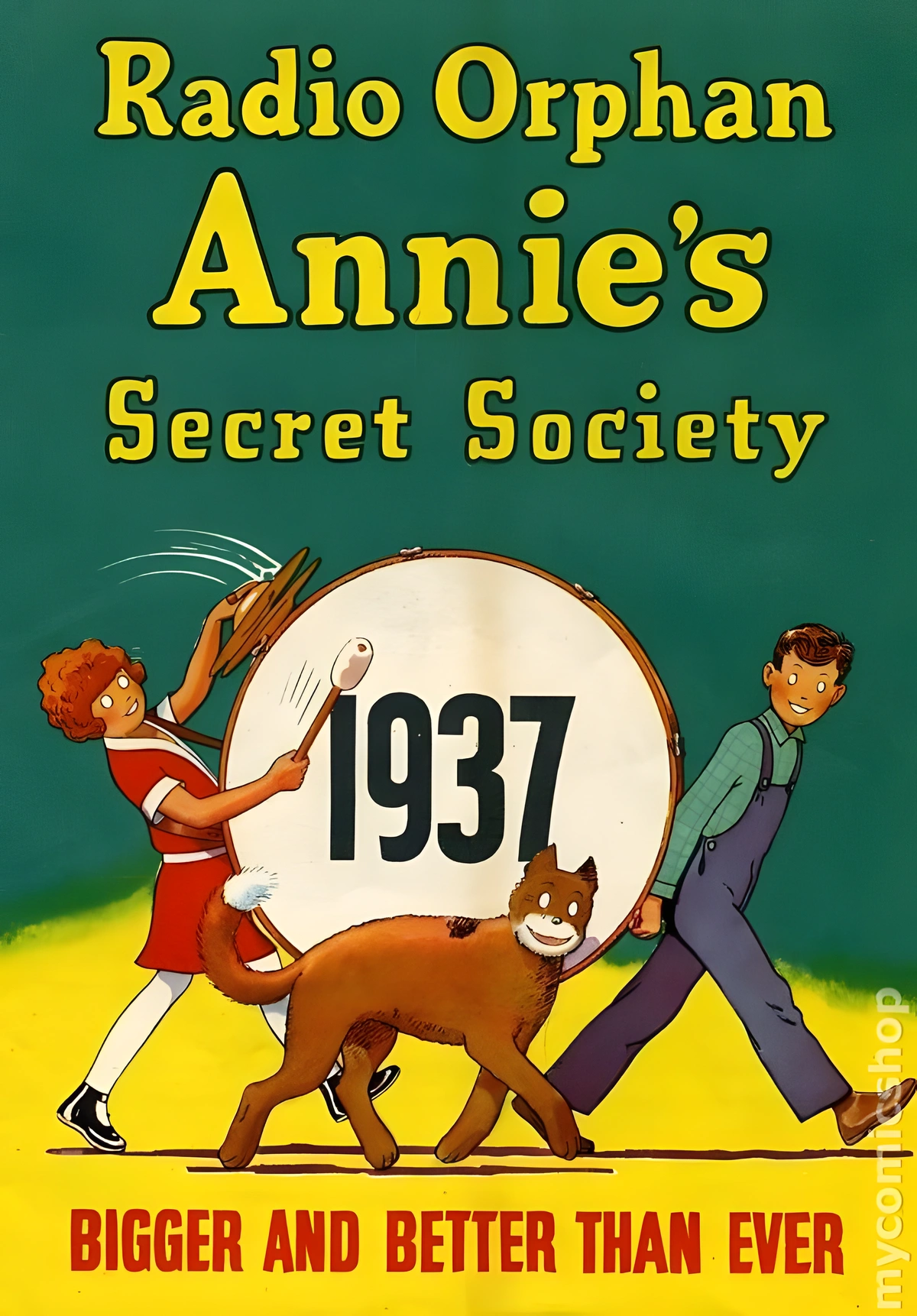
Little Orphan Annie
Where Children's Radio Began
Little Orphan Annie holds a specific place in broadcasting history: it was the first late-afternoon children's serial on American radio, and the template every juvenile adventure program that followed it was built on. When the show arrived on WGN Chicago in 1930 and then moved to the Blue Network on April 6, 1931, there was nothing quite like it — fifteen minutes a day, six days a week, aimed squarely at kids who had just gotten home from school. The action was breathless, the dialogue carried all the drama, and the heroes were themselves only ten years old. Within a year it had taken children across the country by storm and established the shape that juvenile serial drama would hold for the next two decades.
The show was based on Harold Gray's comic strip and kept Annie recognizably close to her origins. Gray (1894–1968) was a Chicago Tribune employee, a World War I veteran, and a self-taught artist who broke into cartooning in 1921 by lettering Sidney Smith's strip before striking out on his own. His original pitch was a boy named "Little Orphan Otto," but Tribune owner Joseph Medill Patterson sent him back to the drawing board with the instruction to "put skirts on the kid." The retooled strip debuted on August 5, 1924, in the New York Daily News — a Tribune-owned tabloid — and by the time radio came calling six years later, Annie was a national figure. On the air she remained a waif taken in by a kindly farm couple, Mr. and Mrs. Silo, known to her as Paw and Maw, living near a place called Simmons Corners. From that humble domestic setting, the stories shot outward into gangsters, criminals, pirates, and exotic locales that had nothing to do with farm country. Annie was almost always the one who figured things out. She came up with the ideas that drove storylines to their climaxes, while the Silos, rustic and good-hearted, often found themselves learning things from their little ward. Her catchphrase, "Leapin' Lizards," came straight from the comic strip.
The Sound of the Show
The opening theme is one of those radio signatures that sticks. It begins "Who's that little chatter box? / The one with pretty auburn locks?" and works in the line "Arf goes Sandy!" — a nod to Annie's dog, who was voiced by Brad Barker, an animal imitator who provided Sandy's arfs throughout the entire run. By any measure, it was one of the catchiest and best-remembered themes on the air during the serial era.
Announcer Pierre Andre was a constant presence, known to listeners as "Uncle Andy," and his commercials for the show's longtime sponsor, Ovaltine, were a production unto themselves — sometimes running as long as three minutes. Andre also fronted the premium offers that became part of the show's identity. Annie was one of the early radio premium-givers, offering decoders and shake-up mugs for ten cents plus aluminum seals from inside Ovaltine cans. Andre described the shake-up mug as a two-in-one gift: a shaker for mixing Ovaltine and a drinking mug when the top was removed. These premiums drove enormous listener engagement and made Ovaltine's connection to the show something that went well beyond a sponsorship tag.
Late in the run, the serial was retitled Adventure Time with Orphan Annie, and the production adjusted its sound to match the new name. The theme moved to the organ, and the opening sound effects expanded to include an airplane, a train whistle, and a steamer's horn — signaling the more overtly action-oriented direction the stories had taken by then.
The Cast Across Twelve Years
The show ran from 1930 to April 26, 1942, and the voice of Annie changed several times along the way. Shirley Bell was the primary Annie for most of the run, though the early years had a separate production broadcast from San Francisco to the Pacific Coast, with Floy Hughes playing Annie in that version. That parallel production was discontinued after the first two years, once Blue Network lines to the West were completed and a single broadcast could reach the whole country.
Around 1934–35, Bobbe Deane briefly took over the role during a contract dispute involving Bell. Then, from 1940 to 1942, Janice Gilbert played Annie through the show's final stretch. Bell had grown up in the role; she was still playing Annie at age twenty when circumstances eventually forced a cast change. The demands of the daily broadcast had been heavy enough that she dropped out of high school to keep up with the schedule, and her paycheck reportedly supported five immigrant Jewish families through the Depression. She kept the voice for the rest of her life — in 1995 she reprised it on Chuck Schaden's Those Were the Days, and friends said she could still produce the distinctive high-pitched Annie until shortly before she died in 2010. In 2005 she published a memoir, Acting Her Age: My Ten Years as a Ten-Year-Old, through Stinehour Press; the book won Best in Show at the Chicago Book and Media Show.
Joe Corntassel, Annie's friend who lived nearby and accompanied her on most of her adventures, was played by Allan Baruck and later by Mel Tormé. The role of Oliver "Daddy" Warbucks, described as a master capitalist and a ruthless dispenser of justice, rotated through Henry Saxe, Boris Aplon, and Stanley Andrews at various points. Warbucks took a distant but fatherly interest in Annie's welfare and remained central to the show's mythology throughout. His sidekick Punjab appeared as well, voiced by an actor whose identity was not recorded. Jerry O'Mera played Mr. Silo and Henrietta Tedro played Mrs. Silo, the two rustic anchors who grounded Annie's domestic life between her wilder escapades.
What the Audience Made of It
The scripts earned a quick reputation for daring and saltiness. Frank Dahm, the primary early writer, had a free hand — he could follow storylines from Harold Gray's comic strip or take off in his own direction, and he often chose the latter. A flood of complaints eventually forced him to tone things down, but by that point the show had already made its mark. Children's reactions to some of the more intense storylines worried their parents. Some kids couldn't sleep. Others were inconsolable when Annie was kidnapped in the course of a story. The drama landed hard.
By 1935, the show was firmly established. Radio Guide noted that children who had been forbidden to listen were often back at the radio the next afternoon anyway — and their parents were sitting beside them. Radio Guide also reported that adults had become regular listeners, quoting the straightforward assessment: "Adults eat it up." The show had managed something that children's programming rarely achieves: it genuinely crossed over, without doing anything to court the adult audience. It just turned out that chasing gangsters and pirates with a ten-year-old was compelling to anyone who tuned in.
The Sponsor Shift and the End of the Run
Ovaltine sponsored Little Orphan Annie continuously from its Blue Network days through the NBC run that lasted until January 19, 1940, and even maintained a concurrent Mutual broadcast from 1937 to 1938 while the NBC deal was active. That kind of sustained commitment from a single sponsor over nearly a decade was unusual, and Ovaltine's name became inseparable from Annie's in the minds of a generation of listeners. Pierre Andre was so closely identified with the Ovaltine brand that when the sponsor moved on, he moved with it.
In 1940, Ovaltine shifted its budget to a new aviation thriller called Captain Midnight and walked away from Annie. The show went off the air, and it looked like the end. About a year later, it was revived on Mutual with a new cast and a restructured premise: Annie had become the sidekick of a flyer named Captain Sparks. The new character's name was a direct plug for the new sponsor, Quaker Puffed Wheat Sparkies. The revival ran on Mutual from January 22, 1940, through April 26, 1942, airing weekdays at 5:45 and then at 5 o'clock. When it finally ended that April, the show had been running in some form for twelve years — long enough to see multiple Annies grow up, a sponsor come and go, and an entire generation of children's broadcasting take shape in its wake. The show was inducted into the National Radio Hall of Fame in 1990, fifty years after Ovaltine had quietly closed the book on its original run.
Annie After Radio
Annie's life on screen began well before the radio show ended. David O. Selznick produced the first film adaptation for RKO in 1932, directed by John S. Robertson and starring Mitzi Green as Annie with Edgar Kennedy as Warbucks; it opened on Christmas Eve that year, Variety panned it, and the New York Daily News was "slightly disappointed." Paramount tried again in 1938 with Ann Gillis in the title role, a script by Budd Schulberg and Samuel Ornitz, and direction by Ben Holmes — one contemporary reviewer called the result "stupid and thoroughly boresome." Neither film stuck.
What stuck arrived on Broadway in 1977, when Annie — music by Charles Strouse, lyrics by Martin Charnin, book by Thomas Meehan — opened on April 21 and ran until January 2, 1983. That musical reset the character for the modern era and spawned its own chain of adaptations: a 1982 film directed by John Huston, a 1999 television film, a theatrical remake in 2014, and a live TV production in 2021. The radio show itself surfaced one more time in popular memory through Jean Shepherd's short story "The Counterfeit Secret Circle Member Gets the Message, or The Asp Strikes Again," collected in In God We Trust: All Others Pay Cash (1966) and later adapted into the decoder-pin sequence of Bob Clark's A Christmas Story (1983). The film used an authentic 1940 "Speedomatic" Annie decoder badge as a prop — the date helps fix the story in December 1940 — though Ralphie's famous decoded message, "Be sure to drink your Ovaltine," was Shepherd's invention. The actual broadcast messages previewed the following episode rather than pitching the sponsor. By the time that scene reached theaters, the radio show had been off the air for more than forty years, and was still being remembered.